Florida HOA boards are dealing with a different reality now
Florida HOA boards have spent the last few years navigating rising insurance costs, stronger storms, and new state requirements around hurricane protection. What used to be treated as a seasonal checklist now feels more like operational planning.
Most boards are not struggling because hurricane preparation is complicated. They struggle because too much of the planning happens after a storm is already in the Gulf.
The boards that handle hurricane season well usually have the same things in place before June 1 every year: a written hurricane protection policy, a clear vendor plan, organized owner communication, and a management team that already knows how the community will operate when a storm approaches.
The process itself is not overly complex. It just needs to be done early enough to matter.
Who is responsible for what during a hurricane in an HOA?
In most Florida HOAs, homeowners are responsible for their homes, insurance coverage, and storm preparation. The association is responsible for the common areas.
For single-family communities, that division is usually straightforward. The association handles amenities, entry features, landscaping, and common property. Owners handle the home itself.
Townhome communities are different.
Every townhome Declaration defines maintenance and insurance responsibility differently. In some communities, the association maintains the roof and exterior walls. In others, responsibility belongs entirely to the homeowner. We regularly see neighboring communities with completely different maintenance structures.
That is why boards should encourage owners to review their governing documents and insurance coverage before hurricane season begins.
One of the most useful spring reminders a board can send is simple: review your documents, confirm your insurance coverage, and understand what the association maintains versus what you maintain personally.
Most post-storm frustration comes from owners learning those boundaries too late.
What changed under Florida law in 2024?
House Bill 293 changed hurricane protection requirements for Florida HOAs in a major way.
The law amended FS 720.3035 and now requires Florida HOAs to adopt written hurricane protection standards. That applies regardless of the community’s age.
Boards are now expected to clearly define acceptable hurricane protection products, colors, and installation standards in advance, rather than handling requests inconsistently through architectural review.
The law also limits the association’s ability to deny owners who install hurricane protection that complies with both the written standards and Florida Building Code requirements.
That includes products like:
• Impact-resistant windows and doors
• Accordion or roll-down shutters
• Reinforced garage doors
• Permanent generators
• Code-compliant roof systems
• Fuel storage tanks and related protection systems
For many associations, the biggest adjustment has been moving from subjective architectural decisions to a published policy owners can actually rely on.
If a board has not adopted a hurricane protection policy yet, it should be a priority before storm season ramps up.
What should the board have ready before June 1?
Most communities need fewer documents than people think. The important part is having them organized and accessible.
A solid hurricane-prep file usually includes:
• The board-approved hurricane plan
• The written hurricane protection policy required under HB 293
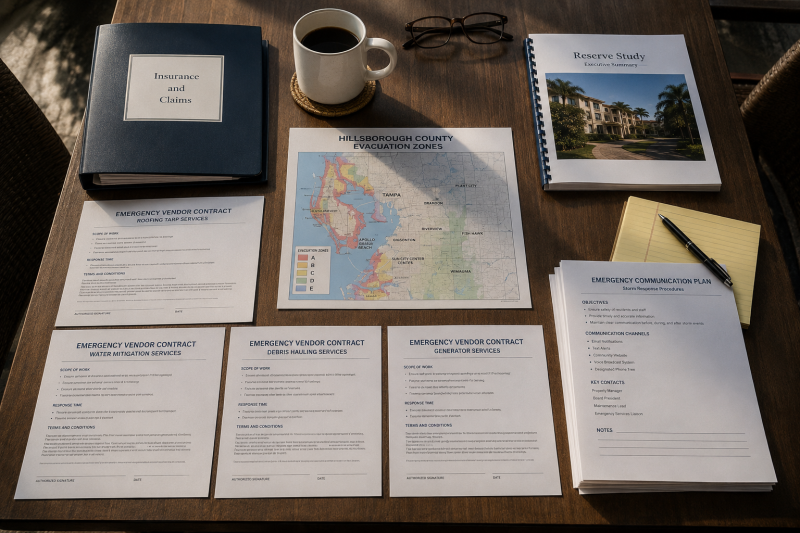
• Emergency vendor contracts and after-hours contacts
• A tested owner communication system
• An updated owner contact list
• A one-page insurance summary from the broker
• Pre-season photographs of common areas
• Emergency reserve planning tied to the named-storm deductible
Vendor relationships are one of the biggest differences between smooth recovery and complete chaos. After a storm, there will be companies using questionable business practices to gain customers. If your community needs to use a vendor in an emergency, it is always better to use a vendor you know and trust
Roofers, restoration companies, electricians, tree crews, and mitigation vendors get overwhelmed immediately after a major storm. Communities that already have agreements and established relationships usually recover much faster.
The insurance summary also matters more than many boards realize.
Every board member should know the association’s named-storm deductible before hurricane season starts. A five percent deductible on a large property can create a major financial obligation before insurance contributes anything.
Pre-season property photographs are another easy win. Photos of roofs, drainage systems, fencing, signage, pools, and common areas create valuable documentation before damage occurs and often help speed up claims afterward.
What emergency powers does the board actually have?
FS 720.316 gives Florida HOA boards specific emergency powers when the Governor declares a state of emergency.
During that period, boards may hold meetings with notice given as practicable, contract for emergency services, mitigate damage, implement disaster plans, levy emergency assessments as permitted by the governing documents, and temporarily close or restrict unsafe areas. Meetings held during this time still need to be recorded and minutes prepared.
Those powers exist so the board can respond quickly during an active emergency.
They are not unlimited.
Once the declared emergency ends, the expanded powers end as well
Boards should also involve legal counsel before making major financial decisions or actions that significantly affect owner rights.
Who decides what gets shut down before the storm?
The board approves the shutdown plan ahead of time, and management executes it when conditions require it.
Trying to debate gate operations, pool closures, or clubhouse procedures while a storm warning is active slows everything down.
A practical HOA shutdown protocol usually covers:
• Clubhouse operations
• Pools and pool equipment
• Playgrounds and dog parks
• Fitness centers
• Entry gates
• Monument lighting and signage
• Irrigation systems
• Trash and mail service
• Lift stations
• Generator fuel and backup systems
Each item should include a trigger point, the responsible party, and the required action.
Gate operations deserve special attention because every community handles them differently. Some associations prefer fail-open access for emergency responders. Others prioritize security and keep gates closed.
Neither approach is automatically wrong. The important part is making the decision before the storm arrives instead of improvising during an emergency.
What happens during the first 72 hours after a storm?
The communities that recover most effectively after a major storm usually follow a written process instead of reacting moment by moment.
The first day focuses on life safety, initial inspections, debris clearance, and stabilization. Boards should communicate quickly with owners, even if there are still unknowns. Short updates confirming inspections are underway, and additional information is coming to help reduce panic.
By day two, the focus shifts toward documentation, vendor coordination, and insurance claim preparation.
By day three, owners generally expect a clearer picture of damage, repair timelines, vendor activity, and next steps.
One of the biggest advantages a board can have after a storm is organized documentation. Photos, receipts, vendor records, and communication logs all help claims move faster and reduce confusion during recovery.
How should the board communicate during a storm?
Owners are usually more forgiving of delays than they are of silence.
The strongest communication plans follow a predictable rhythm. Most associations send a pre-season reminder in May, storm updates once a system enters the cone, pre-landfall notices about closures and preparation, and regular recovery updates after the storm passes.
Consistency matters more than polished language.
The communities that communicate best during hurricanes usually operate through one coordinated voice. Management and the board follow the same process, and individual directors avoid sending separate or conflicting updates on their own.
Confusion spreads quickly when owners start hearing different versions of the same situation from different board members.
Where does Ameri-Tech fit into hurricane preparation?
Well-prepared boards aren’t scrambling during the storm. The preparation work was done months earlier.
For many of our associations, that work starts in spring with planning, vendor coordination, communication prep, and operational readiness. By the time a storm approaches, the process is execution, not improvisation.
Ameri-Tech client associations have access to the relationships we’ve built with reliable vendors and insurance agencies from our 25+ years of being in business. When the Governor declares a state of emergency, our team becomes a central point of contact and communication.
During a storm cycle, our emergency response team is available for reporting damages and coordinating mitigation as soon as the storm moves from the area.
Florida HOA recovery moves fast. The boards that come through it cleanly are the ones whose management teams already have documentation, vendor contacts, inspection reports, and communication systems in place when hurricane season begins.
Florida statute references are current as of 2026. Boards should consult their association counsel for legal interpretation, their Florida-licensed insurance broker for coverage questions.
Talk to Ameri-Tech
If your board is reviewing hurricane procedures, updating vendor coordination, or preparing for another storm season, we would be glad to help.
Some boards already have strong systems and just want sharper communication and vendor coordination. Others are starting from scratch. Either way, hurricane preparation works best when it starts before a storm is in the forecast.
Ameri-Tech has managed Florida community associations since 1999 and currently supports more than 250 associations across Pinellas, Hillsborough, and Pasco counties. Our teams work with boards year-round on operational planning, emergency preparedness, communication systems, and storm-response coordination, all designed specifically for Florida HOA communities.